When discussing the vehicle's active safety AEBS collision avoidance system, attention often focuses on components like LiDAR and the warning unit—these "perception frontends" —while frequently overlooking the critical execution component: the wire-controlled proportional motor, which determines whether the entire automatic braking system can be effectively implemented and whether braking is smooth and controllable.
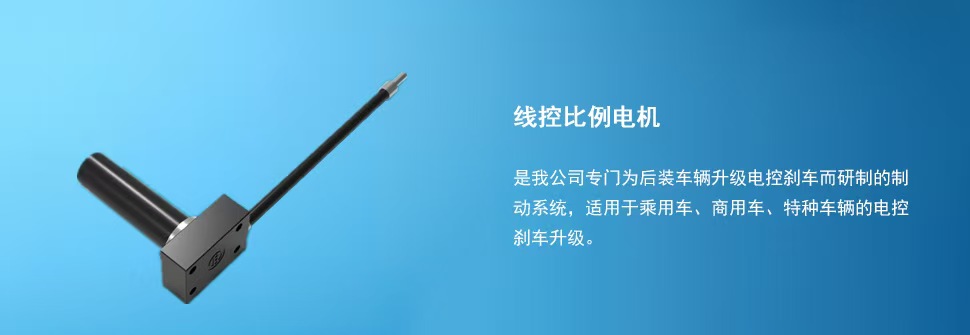
A significant number of fuel-powered vehicles, new energy commercial vehicles, and specialized on-site vehicles on the market lack factory-installed line-controlled braking systems, leaving retrofit safety upgrades long plagued by three major challenges: installation difficulties, abrupt braking responses, and power-off locking issues. Today, we focus on Henan Huhang Group's (www.hu-hang.com) self-developed line-controlled proportional motor, examining how this domestically produced braking actuator addresses the final hurdles in implementing AEBS systems for aftermarket applications.
I. The Three Major Core Pain Points in Post-Market Industry Solutions
When installing automatic collision avoidance systems, many fleets, mines, and logistics parks often encounter difficulties at the braking execution stage.
1. High installation requirements
Traditional hydraulic and pneumatic proportional valves are only compatible with vehicles equipped with original factory gas/oil systems; new energy light trucks and passenger cars lack dedicated gas or oil circuits, making installation impossible—a significant gap in retrofit solutions.
2. The braking force is uncontrollable, resulting in a poor driving experience.
Traditional brake actuators offer only two settings: "no braking" or "full emergency braking." Upon triggering the warning, they apply sudden braking abruptly, causing severe cargo jolting and significant discomfort for both drivers and passengers, resulting in a poor riding experience and potentially leading to secondary accidents.
3. Lack of safety redundancy, high failure risk
When a standard motor vehicle loses power, its brakes lock instantly, leaving the vehicle immobilized and posing significant road safety risks.
With years of expertise in the aftermarket market, we have developed specialized linear-controlled proportional motors—eliminating pneumatic valves and featuring pure electric direct-drive pedals—that are perfectly compatible with all vehicle models.
II. Self-developed Line-Controlled Proportional Motor: Four Major Breakthroughs in Core Technologies
1. Linear proportional braking for smoother stepwise deceleration
Utilizing a high-precision motor coupled with a reduction mechanism, the system outputs multi-level braking forces upon receiving signals from the AEBS controller: mild deceleration for short-distance warnings, moderate emergency braking when danger approaches, and full-power braking at collision thresholds. The adjustable braking force ratio prevents abrupt, harsh stops.
The motor features low inertia and millisecond-level response time, ensuring zero delay from risk detection to braking activation, thereby significantly reducing emergency braking distance.
2. Self-recovery design upon power outage ensures robust safety assurance
A unique self-recovery mechanism: when the vehicle loses power or experiences system failure, the motor automatically rebounds. This addresses the common issue of failure in traditional actuators and provides dual safety assurance during operation.
3. Wide-voltage full-range compatibility, compatible with all aftermarket vehicle models
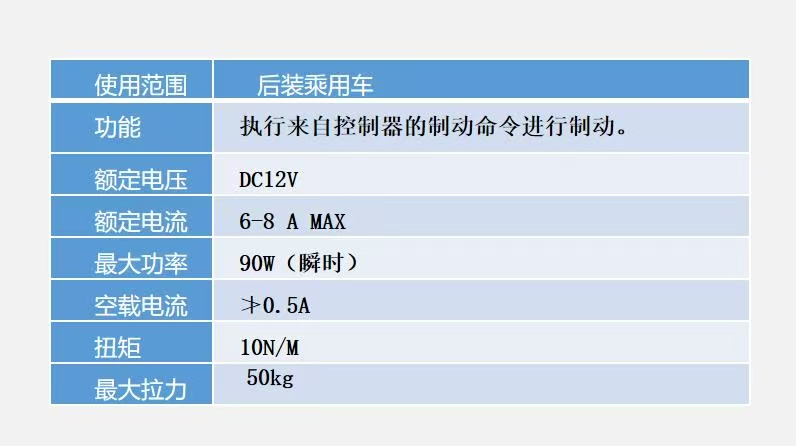
Supports dual voltage (DC 12V/24V), with a maximum instantaneous power of 90 W, maximum pulling force of 45 kg, and effective braking stroke of 10 cm. No modifications to the vehicle's existing air or oil systems required.
• Direct, non-invasive installation on new energy logistics light trucks and electric passenger vehicles;
• Compatible with fuel trucks, buses, in-factory forklifts, and loaders;
4. High-strength wear-resistant structure, suitable for harsh operating environments
The reduction gear is constructed from specialized wear-resistant steel and equipped with built-in buffer protection devices, ensuring minimal tooth damage even under prolonged repeated braking cycles. The entire unit features a sealed dust-proof design capable of withstanding dust exposure, high humidity in port environments, and frequent start-stop operations under harsh industrial conditions, significantly reducing subsequent maintenance and replacement costs for the fleet.
III. Implementation in Three Key Scenarios: Addressing the Gap in Post-Mount Brake Installation
Scenario 1: New energy logistics vehicles/city buses
The tram lacks an air-assisted braking system and cannot accommodate a proportional valve; instead, it features a wire-controlled proportional motor directly driving the brake pedal. These components are paired with AEBS (Active Emergency Braking System) for blind-spot collision prevention, front vehicle warning, and adaptive braking in urban congested areas, ensuring the safety of both passengers and cargo.
Scenario 2: Forklifts, loaders, and internal transfer vehicles within the factory premises
The factory area features mixed pedestrian and vehicle traffic, posing significant risks at low speeds and close distances. The motor's light-duty, gradual braking function prevents cargo displacement during sudden stops. On-site operations do not result in vehicle blockages that obstruct passages.
Scenario 3: Self-unloading trucks for short-distance transportation in mines and open-pit mines
Under heavy-load downhill conditions, the motor provides stable and continuous braking force in conjunction with the global task planning system, enabling gradual deceleration before encountering oncoming vehicles on curves. Compared to hydraulic or pneumatic modification solutions, this approach reduces the modification duration by 70% without requiring alterations to the vehicle's hydraulic piping system.
IV. Powered by our self-developed end-to-end braking matrix, it adapts to various vehicle types as needed
Many customers confuse the three types of linear control actuators; here we clearly distinguish their adaptation logic:
1. Line-controlled proportional valve: Suitable for heavy-duty pneumatic brake mining trucks, heavy-duty trucks, and passenger vehicles;
2. Line-controlled proportional oil valve: Suitable for hydraulic-braked mine cars, loaders, and forklifts;
3. Line-controlled proportional motor: Suitable for all types of vehicles, including new energy vehicles without air or oil systems, passenger cars, and light trucks, designed for lightweight, non-destructive retrofitting.
All three types of execution components are independently developed and manufactured, with deeply integrated software/hardware algorithms that ensure seamless operation of the LiDAR system and AI-based collision avoidance module. The entire system achieves perfect signal synchronization without latency, requires no third-party components, and delivers optimal compatibility across all security solutions.
V. Value of Domestic Components: Reducing Overall Fleet Modernization Costs
1. Lower installation costs
The pure electric direct-drive solution eliminates oil circuits, gas lines, and piping components, significantly reducing labor and material costs per vehicle.
2. Deliverable timeline is controllable
The motor has ample现货 inventory; batch upgrades to the fleet can be delivered quickly without waiting for imported actuators from overseas.
3. Fully Independent Intellectual Property Rights
It features a complete structural design and patented control algorithms, complies with domestic procurement standards for state-owned enterprises and facilities, and eliminates supply chain bottlenecks.
A comprehensive active safety system consists of three key components: the radar identifies potential risks, the control unit evaluates them, and the electrically controlled proportional motor provides the ultimate solution to mitigate these risks.
Henan Huhang Group not only develops perception and early-warning systems but also focuses on advancing core braking execution hardware. Addressing a gap in the aftermarket retrofit market, it has introduced differentiated linear-controlled proportional motors to overcome limitations in automatic braking upgrades for new energy vehicles and specialized on-site vehicles. Utilizing domestically produced precision components, the company enables every existing vehicle to undergo cost-effective and highly safe active protection upgrades.
For business consultations, bulk component procurement, or vehicle retrofitting solutions, visit Hu Hang Group's official website at www.hu-hang.com; hotline: 0371-86556688; WeChat business ID: 18569912153.