Road conditions are becoming increasingly complex, and large commercial vehicles, hazardous material transport vehicles, buses, and specialized engineering vehicles—due to their extensive blind spots, long braking distances, and high risk of driver fatigue—have long been the primary culprits behind road accidents. Traditional passive safety measures can no longer adequately address sudden risks in complex road environments; thus, ADAS (Advanced Driver Assistance Systems) have become an indispensable core component of vehicle safety systems.
Henan Huhang Group (www.hu-hang.com) has dedicated over a decade to advancing active vehicle safety. Leveraging its proprietary LiDAR technology and three core algorithmic solutions, the company has developed comprehensive ADAS systems that integrate multiple sensors seamlessly, overcoming limitations of traditional visual recognition. These systems maintain stable detection and rapid response even under extreme conditions such as heavy rain, dense fog, nighttime visibility challenges, and curve blind spots. The group provides integrated active safety solutions combining hardware, software, and cloud-based management for diverse applications including public transportation, long-distance logistics, hazardous material transport, specialized vehicles at ports and airports, construction machinery, and forklifts, leveraging cutting-edge technology to preempt risks and ensure safer travel.
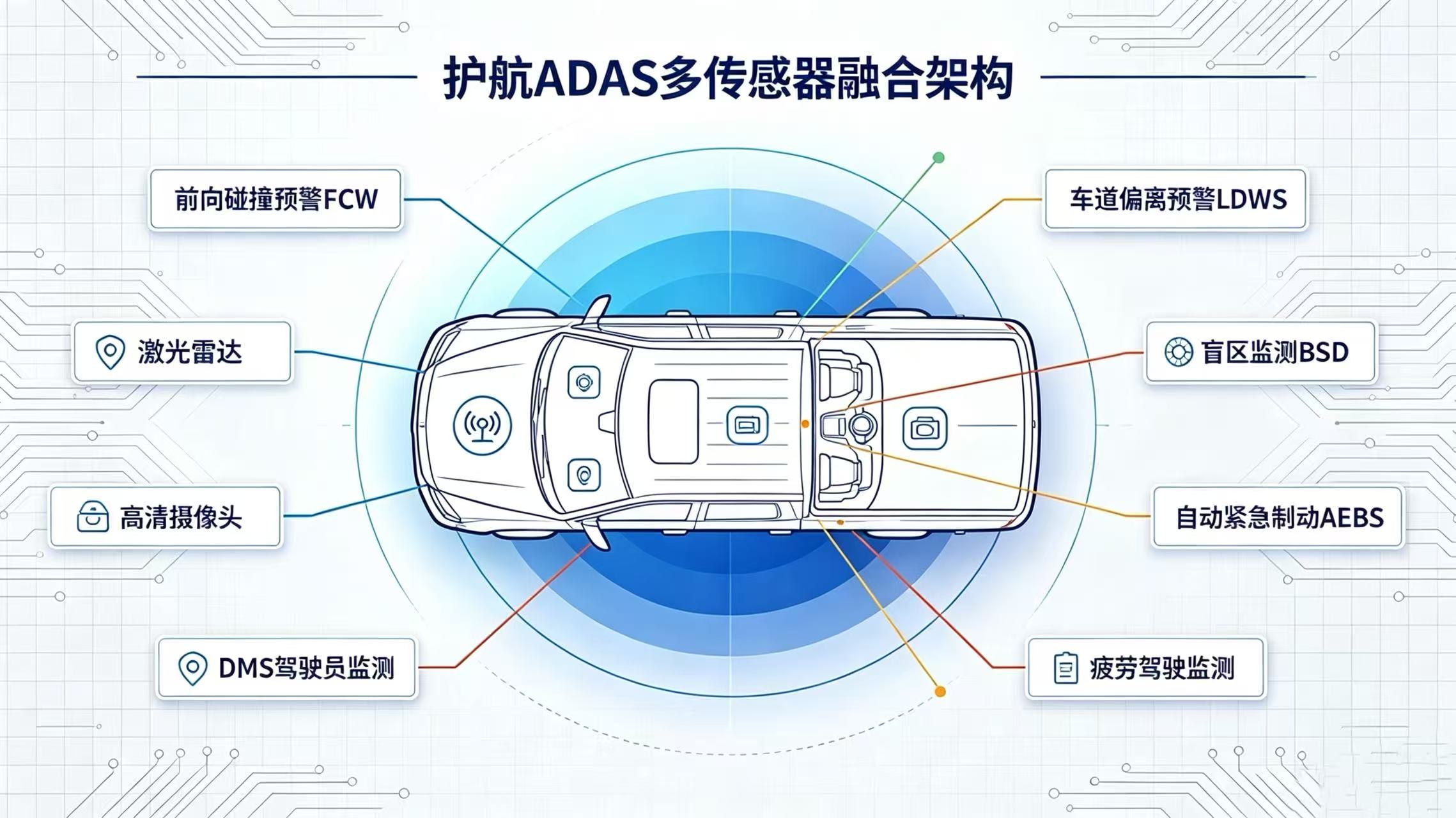
1. Three Key Technical Pillars: Building the Foundation for ADAS Safety Protection
The Escort ADAS system is designed around three core principles: precise perception, millisecond-level decision-making, and tiered intervention, forming a three-tiered closed-loop safety protection mechanism. Unlike conventional single-camera vision solutions on the market, it offers significantly enhanced interference resistance and environmental adaptability.
1. Multi-sensor, comprehensive three-dimensional perception network
2. The system integrates self-developed LiDAR and high-definition night vision cameras to establish a comprehensive 360° environmental perception network around the vehicle, capable of detecting targets at distances up to 260 meters and identifying, tracking, and assessing risks posed by obstacles, pedestrians, non-motorized vehicles, and other vehicles within 0.1 seconds. It maintains stable environmental data output even under harsh conditions such as strong backlighting, heavy rain with dust, or complete darkness at night, significantly reducing false alarms and missed detections.
2. A three-tier intelligent intervention mechanism for hierarchical mitigation of collision risks
3. The ADAS system eliminates a one-size-fits-all braking logic and activates tiered protection based on risk levels:
• Level 1 alert: An audible and visual alarm in the vehicle alerts the driver to correct the operation promptly.
• Second-level intervention: The system automatically controls oil flow and reduces braking speed, pre-tightens the braking system in advance, thereby shortening the subsequent braking distance.
• Level 3 Emergency Braking: When the driver fails to respond to the risk and a collision remains imminent, the system automatically applies emergency braking to prevent or mitigate the impact.
The system natively integrates five core modules: AEBS (Automatic Emergency Braking), LDWS (Lane Departure Warning), BSD (Right-side Blind Spot Monitoring), FCW (Forward Collision Warning), and DMS (Driver Behavior Monitoring). It simultaneously detects hazardous driving behaviors—including fatigue driving, phone usage, distracted head-down posture, and failure to wear seat belts—providing dual control over both environmental and human-related risks.
3. Cloud-based vehicle management platform enables full-chain traceability of safety data
4. Hardware warning data is synchronized and uploaded to support the dedicated vehicle networking management cloud platform, enabling enterprise managers to remotely monitor vehicles' real-time locations, driving trajectories, speeding records, ADAS alert events, and driver behavior scores. The system automatically generates monthly safety analysis reports that identify high-risk road sections and poor driving habits, assisting enterprises in implementing targeted safety training and assessments, thereby shifting safety management from post-incident accountability to proactive prevention.
2. Customized implementation across all industry scenarios, ensuring ADAS compatibility with diverse driving environments
1.Built on a modular hardware architecture, the ADAS system support solution features customized algorithm tuning tailored to the specific characteristics of vehicles across various industries and has been successfully implemented in six core application scenarios.
2.Urban Public Transport Scenarios
3.To address high-frequency safety risks such as right-turning maneuvers by buses and construction vehicles in the hazardous "death crescent" curve, and pedestrian crossings, the system has enhanced right-side BSD blind-spot monitoring and intersection pedestrian detection capabilities to ensure urban public transportation safety. These measures have now been widely implemented across multiple public transit systems.
4.Scenarios involving vehicles transporting hazardous chemicals
5.A collision involving hazardous goods trucks carries severe consequences. The ADAS system enhances long-range forward detection and electronic fence-based access control, strictly avoiding sensitive areas such as schools and urban centers, while continuously recording warning data to meet the stringent regulatory traceability requirements of the hazardous materials transportation industry.
6.Mainline logistics vehicles; heavy-duty trucks for cold-chain freight transportation
7.Address issues such as fatigue driving on long-distance highways, nighttime rear-end collisions, and lane departure; provide continuous, stable monitoring during extended journeys to reduce traffic accidents and operational losses on major routes.
8.Engineering waste removal trucks, heavy-duty commercial concrete transport vehicles, mining vehicles
9.Given the environmental characteristics of mining vehicles, construction site dust, nighttime operations, and extensive blind spots on narrow site roads, the system enhances night vision recognition and close-range obstacle detection by integrating 360° panoramic surveillance imagery to eliminate complex visual blind spots at construction sites.
10.Specialized vehicles such as mining vehicles, port vehicles, airport vehicles, loaders, and forklifts
11.To address personnel mixing risks in industrial enclosed environments, we have developed a customized close-range collision prevention algorithm that enables intrusion detection alerts, automatic braking, and external audio-visual warnings. The IP67-rated hardware is designed to withstand harsh outdoor conditions with high dust concentrations and humidity levels.
12.Enterprise Commuting, Business Fleet
13.The architecture has been streamlined and optimized for passenger vehicles, retaining essential features such as collision warning, lane departure detection, and driver distraction monitoring, while balancing cost considerations with fundamental safety requirements.
III. Compliance with National Standard Upgrades: Ensuring Early Adaptation of ADAS Systems to the Mandatory GB39901-2025 AEB Standard
The mandatory national standard GB39901 for automotive Automatic Emergency Braking (AEB) systems, to be released in 2025, will achieve full coverage across all vehicle models in phases from 2028 to 2030. It significantly expands test scenarios—including pedestrians, non-motorized vehicles, complex curves, nighttime conditions, and rain or fog—and sets higher requirements for system recognition accuracy, response speed, and robustness across various scenarios.
As a provider of AEB and ADAS solutions, Henan Escort Group's systems have obtained authoritative certification from the National Automotive Quality Supervision and Inspection Center and EU ECE regulatory certification. Capable of effective collision prevention across speed ranges from 1 to 120 km/h, they can identify all types of road targets—including pedestrians, two-wheeled vehicles, and motorcycles—and demonstrate exceptional performance in challenging scenarios such as curves and blind spots. These systems assist automotive and transportation companies in completing compliance upgrades proactively, thereby mitigating potential future regulatory risks.
IV. Upholding Our Original Mission: With technology as the foundation and safety as the core, we strive to establish a benchmark for domestically developed active safety solutions.
Over the past decade, Henan Hushang Group has steadfastly pursued self-developed core hardware solutions, independently creating all critical components—including LiDAR systems, linear-controlled proportional pneumatic valves, proportional hydraulic valves, and brake actuators—thereby breaking the monopoly of foreign parts suppliers. This approach not only ensures the stability and iterative development autonomy of the entire system but also delivers cost-effective, customizable, and localized service solutions for domestic clients.
Currently, our escorted ADAS systems and comprehensive active safety solutions serve not only major domestic automakers, state-owned enterprise logistics departments, public transport groups, ports and airports, as well as industrial and mining companies, but also find applications in overseas markets including Australia, South Korea, Europe, Southeast Asia, and the Middle East.
Evolving from simple warnings to comprehensive monitoring, and from passive protection to proactive intervention, Hushang Group remains committed to its core mission of reducing road accidents and safeguarding every journey. The company continuously refines ADAS algorithms and hardware technologies, delivering all-scenario intelligent driving assistance solutions that strengthen technological safeguards for road safety.
National Service Hotline: 0371-86556688
Official Website: www.hu-hang.com
English Global Website: www.huhangcas.com
Specializing in the research, development, and practical implementation of ADAS/AEBS systems for active safety, vehicle collision prevention, and intelligent safety solutions for specialized vehicles.