1. System operating principle
The Collision Avoidance System (hereinafter referred to as "the System" or "the Product") (CAS) is a system that utilizes LiDAR and video cameras to monitor obstacles (pedestrians) ahead of the vehicle in real-time. It calculates the distance and relative speed between the vehicle and the obstacles (pedestrians) ahead, and issues warning messages to the driver when there is a potential forward collision hazard and the warning conditions are met. The system itself can take braking measures to avoid or mitigate collisions. The Collision Avoidance System CAS is a human-priority auxiliary safety system, and the driver remains the primary responsible party for driving and control..
2. System schematic diagram
2.1 Design scheme:
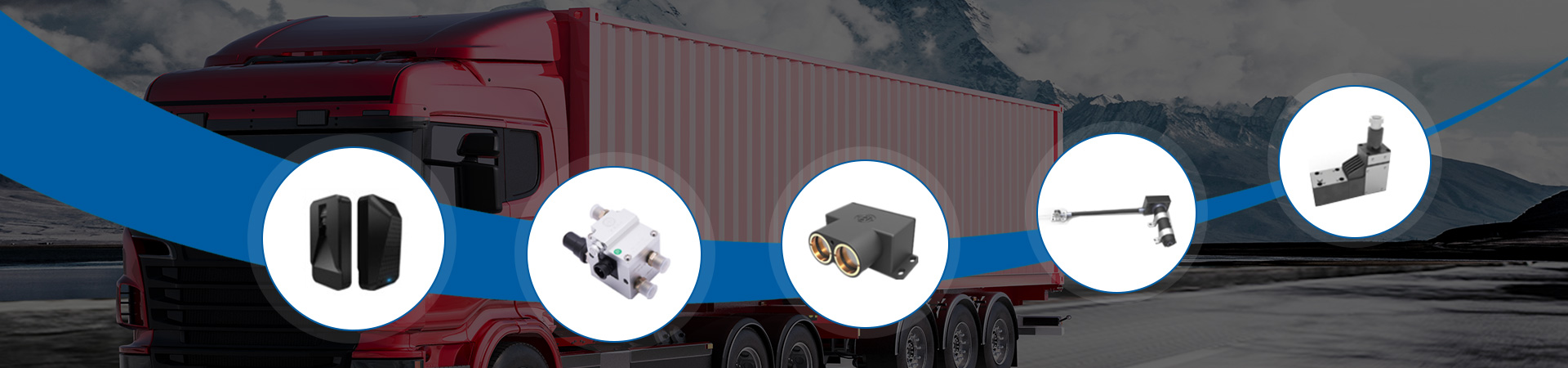
The system perception sensor integrates a laser radar and a video camera, which not only extends the detection range but also addresses the complex and variable urban road environment. The system's braking control strategy often adopts a light braking approach to remind drivers to drive safely. In case of emergencies, the system can prevent collisions and help drivers enhance their ability to avoid risks.
2.2 System schematic diagram:
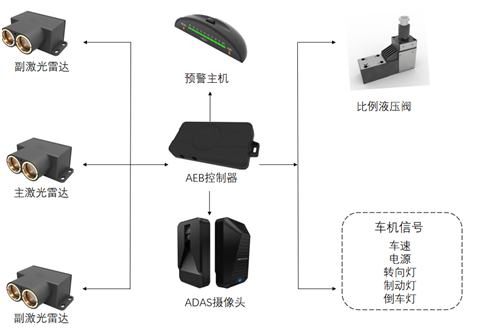
3. System functions
Forward collision warning: The radar detects in real-time parameters such as the distance between the host vehicle and the target vehicle ahead, the speed of the host vehicle, and the relative speed. It can comprehensively assess the collision risk level of slow-moving or stationary vehicles ahead and issue a collision warning signal to the driver when necessary.
Pedestrian collision warning: The radar detects pedestrians (and electric vehicles) in the lane ahead of the vehicle in real time, comprehensively evaluates the collision risk level of slow-moving or stationary pedestrians ahead, and sends a collision warning signal to the driver when necessary.
Lane departure warning: The system utilizes dynamic video camera technology to monitor the lane markings on both sides of the vehicle's driving lane in real-time. It calculates the vehicle's lateral position and distance relative to the driving lane markings in real-time, and emits a warning signal when the driver unintentionally deviates from the lane, reminding the driver to maintain safe driving in the original lane.
u Automatic emergency braking: When the system issues a warning message and the driver fails to take necessary measures or evasive actions to avoid the danger, and there is still a potential collision risk, the system automatically initiates emergency braking to slow down or stop the vehicle, thereby reducing the probability of accidents caused by forward collisions.
4. System Features and Advantages
4.1 System Features
u LIDAR has strong anti-interference capability
The radar boasts strong anti-interference capabilities, effectively resisting interference from rain, fog, dust, and vehicle exhaust, thus preventing accidental braking.
u Adaptive algorithm
During emergency braking, the system continuously adjusts the braking strategy for the next moment based on the braking data from the previous moment. By continuously adjusting the braking force, it achieves the same braking effect on different road surfaces and vehicles.
u Accurate mathematical model
A practical and precise mathematical model integrating optics, electronics, electrodynamics, and mechanics has been established, which can automatically calculate the safe distance and enable the system to effectively brake even at speeds as low as 1 km/h.
Unique recognition algorithm
It can accurately recognize objects such as road signs, curves, and ramps, as well as overtaking and lane changing behaviors, to avoid accidental braking.
4.2 System Advantages
The minimum braking speed can reach 1km/h;
The anti-tailgating effect of the u system is the same at night as it is during the day;
The system automatically adjusts the braking force, eliminating the need for manual setting and adjustment;
The brake actuator added does not alter the original vehicle brake assembly;
u Real-time feedback on braking effect is provided, with automatic adjustment of braking force to enhance braking smoothness and avoid the phenomenon of "sudden braking".